

Business Automation with AI Agents for Small and Mid-Sized Businesses
Small and mid-sized businesses already have the tools. The gaps between them cost time. Here is how business automation and AI agents should actually work.
Originally published on LinkedIn.
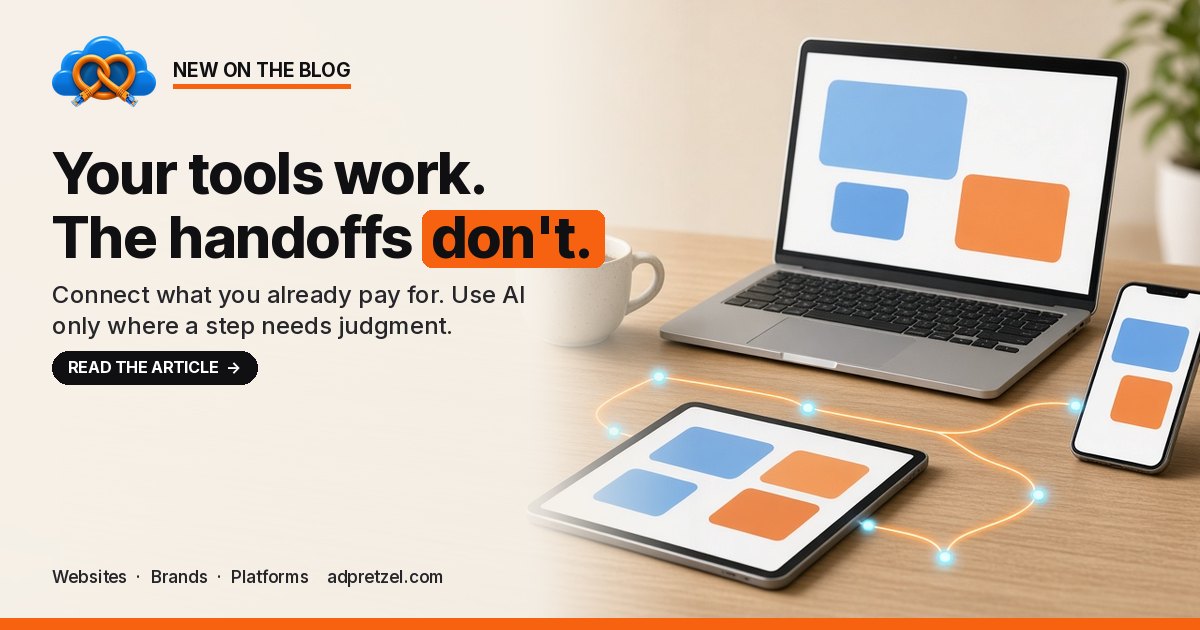
Most business owners we meet are not short on tools. They are short on time. They already pay for a website form, an inbox, a spreadsheet, a calendar, and an invoicing app. Leads still sit in email. Quotes still get retyped. Follow-up still depends on someone remembering. The software is there. The handoffs between the software are not.
That is the problem business automation is supposed to solve. In 2026, a lot of that conversation is happening under a new label: AI agents. Some of that is useful. Some of it is a new name for work that should have been a simple connection between tools you already own. If you run a small or mid-sized business, the difference matters, because it decides whether you get your week back or just add another subscription.
The patchwork is the real system
A growing company rarely has one platform. It has a stack that accumulated as the work appeared. A form captures a lead. Someone copies it into a CRM, or into a sheet that is doing the job of a CRM. A quote is written in a document, then typed again into accounting. A job is scheduled on a calendar that does not talk to the invoice. A customer replies, and the thread lives only in one person's mailbox.
None of those tools is necessarily the wrong tool. Payments might already work in Stripe or Square. Books might already live in QuickBooks. The team might already live in Slack, Gmail, Outlook, or Google Calendar. The shop might already sell or book through Shopify. The failure is the gap between them. Every gap becomes a manual step, and every manual step becomes a delay or a mistake.
This is why "buy an AI tool" often disappoints. A model cannot fix a process that has no place to put the result. If a lead has nowhere to go except an inbox, an agent that drafts a reply still leaves you with the same pile. Automation has to start with the path the work should take.
What should run on its own, and what needs AI
We draw a hard line in our work at Ad Pretzel: repetitive steps should already run, and AI is used only when a step actually needs it.
A lot of the busywork in a small or mid-sized business does not need a model. If a website form should create a lead, assign an owner, and put a follow-up on a calendar, that is workflow automation and CRM automation. If an accepted quote should open a job and pass the total to invoicing, that is systems integration. If a payment in Stripe should mark the invoice paid and update a dashboard, that is an API doing its job. These steps are rule-based. They should be reliable, logged, and boring.
An AI agent is useful when the input is messy or the next step depends on language, not on a fixed field. Examples include reading an unstructured email and drafting a first response for a person to approve, classifying a request so it reaches the right queue, or pulling details out of a document so a teammate is not retyping them. Even then, the agent should write into the same system your team already runs, and a person should approve anything that faces a customer or moves money.
The failure mode we see in the market is the opposite: a chatbot dropped onto a messy process, sold as "AI for the business," while the copy and paste continues in the background. That is not automation. That is another window to check.
Connect what you already pay for
The most practical automation work, in our view, is not a rip-and-replace. It is a decision to keep what already works and wire it into one platform the team can actually run.
That is the idea behind our Systems and Business Automation service. We build for companies that do not need a new stack. They need the stack they have to hand work to the next step without a person in the middle. Typical work includes lead capture and CRM automation, so website forms, calendars, and ads feed a pipeline and leads do not die in an inbox. It includes quotes, proposals, and production, so a job can move to a board without being retyped. It includes systems integration with tools such as Stripe, QuickBooks, Square, Zapier, HubSpot, Slack, Meta, Gmail, Outlook, Google Calendar, and Shopify, plus other platforms through API integrations.
AI belongs in that picture as an add-on for the steps that need a model, not as the product you have to go learn in place of your own operation. The studio is development-first. Intake, CRM, dashboards, and APIs should live in one custom platform instead of five products that each cover a piece. Marketing comes after that system can take a lead. We have done this kind of platform work for more than 50 brands, including live client products such as LMS and CMS platforms, distribution admin tools, and field operations SaaS.
How to start without boiling the ocean
You do not have to automate the whole company in one project. In fact, you should not.
Pick one workflow that already costs you time every week, and that has a clear start and a clear finish. "Leads from the website to a first follow-up" is a good first target. "Accepted quote to job board and invoice" is another. Write the steps as they happen today, including the ugly ones. Mark which steps are identical every time, and which ones require judgment.
Then ask a studio to keep your current tools wherever they still do the job, to automate the fixed handoffs first, and to use an agent only where the work varies. Ask for the scope, the quote, and the running costs in writing. Ask what a person on your team will still approve. Pricing for this kind of work should be a custom quote, because the stack and the workflow are yours, not a template.
If you do that, "AI agents" stop being a trend you have to buy into, and become one tool inside a system that already runs. The point is not to have more software. The point is to give the team their time back so they can focus on bigger and better things.
If you want to talk through a workflow, you can request a free quote. Email info@adpretzel.com.
Related Insights
If leads already go cold before anyone follows up, start with The Shop Is Closed. The Leads Are Not. For a wider look at where AI should stay in a human approval loop, read How Fortune 500 Companies Actually Use AI at Work in 2026. And if you are choosing a partner to build this kind of system, see How to Choose an AI Agency to Build Custom Tools for Your Business.
Found this helpful? Share it:
Prefer AdPretzel in Google & Gemini
Add us as a Preferred Source so AI Mode, AI Overviews, and Top Stories highlight our Insights when you search.
Or open Google Source preferences.
Ready to put these ideas to work?
From web design to full-funnel campaigns, AdPretzel helps brands turn insights into measurable growth. We blend strategy, creative, and clean implementation so your marketing doesn't just look good. It performs.
Talk to us about your next move
Whether you need a sharper website, a clearer funnel, or a full digital rollout, we can help you prioritize the next right steps.
Get in touch with AdPretzel