

How to Choose an AI Agency to Build Custom Tools for Your Business
A practical checklist for choosing an AI agency to build custom tools, connect the software you already use, and take repetitive work off your team's plate.
Originally published on Medium.
When a business searches for an AI agency, it is usually looking for something more specific than a chatbot demo. It wants a partner that can build a custom tool, connect it to the software the team already uses, and take repetitive work off someone's plate. This guide is a practical way to choose that partner. It is written for owners and operators of small and mid-sized businesses, not for enterprise procurement teams buying a multi-year transformation program.
A useful first test is simple. Can the firm explain the job in your words, name the tools that will stay, and say where a person still has to approve the work? If the pitch starts with a model name and never gets to your intake, your inbox, or your invoices, keep looking.
What people mean by "AI agency"
The label is messy. In practice, "AI agency," "AI development company," and "AI automation agency" can point to very different businesses.
Some firms train or fine-tune models, or they sit close to a single model vendor. Some place "AI developers" on your team and leave you to direct the work. Some specialize in workflow tools and connect apps through Zapier, Make, n8n, or similar. Some are custom software studios that build the system your team runs every day, then add automation, and only then add AI where a step actually needs a model.
Those are not interchangeable. A staffed engineering bench is a good fit if you already know what to build. A workflow specialist is a good fit if the process is stable and the tools already talk to each other. A custom studio is a better fit if the real problem is the system itself: leads stuck in email, quotes retyped by hand, a spreadsheet acting as the source of truth, and five products that each cover a piece of the work.
You do not need to hire all of these. You need the one that matches the job you have this year.
Start with the job, not the model
Write down one workflow before you take a sales call. Be concrete. For many growing companies the first problems look like this:
- A website form, an ad lead, or a calendar booking lands in someone's inbox and waits.
- A quote is retyped from a chat, a spreadsheet, or a PDF into another tool.
- Follow-up depends on someone remembering.
- The same customer details are copied into a CRM, an invoicing app, and a job board.
- A weekly report is assembled by hand from three systems that do not agree.
If the step is the same every time, and the data is already structured, a workflow or an integration may be enough. If the step varies (reading a messy email, drafting a first reply, classifying a document, pulling a price from notes that are not in a tidy field), a model can help. If a firm offers an "AI agent" for a problem that is really a missing pipeline, a missing job board, or a form that does not talk to the CRM, you are being sold a layer on top of a mess.
The right question is not "which model do you use?" The right question is "what happens to this piece of work, in our tools, on a busy Tuesday?"
A checklist you can bring to any first meeting
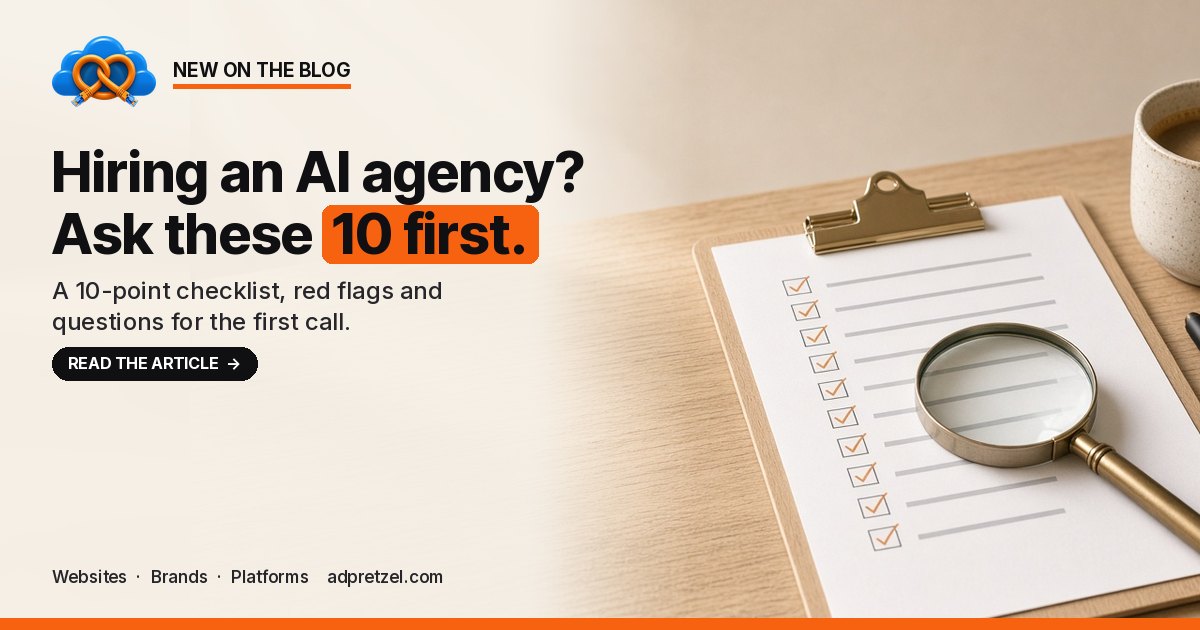
Use the same ten checks with every firm, including us. A serious partner will be able to answer them in writing.
- Can they show live systems, not only a slide deck? Ask to see work that is actually in use.
- Will they keep the tools you already pay for? If you already run payments, email, or accounting in products that work, the build should connect to them. A rip-and-replace should be a last resort, not the opening move.
- Do they say when AI is the wrong tool? You want a partner that will automate a repetitive step with rules or an API when that is enough, and use a model only when the step needs one. "We will just put a chatbot on it" is not a plan.
- Is it clear where the work will live? Someone should be able to point to the system of record: the CRM, the job board, the inbox, the invoice tool. If the agent writes somewhere and the team still works somewhere else, the copy and paste will come back.
- What can the system do on its own, and what needs a person? Quotes going out, replies to unhappy customers, and anything that moves money should have a human checkpoint unless you have explicitly chosen otherwise.
- Who owns the code, the prompts, the data, and the accounts? You should know what you own, what is licensed, and which third-party accounts stay in your name.
- Are scope, price, and running costs in writing before the build starts? A custom quote is normal for this kind of work. An open-ended promise with no scope is not. Ask what you will pay after launch too (hosting, model usage, support), not only the build fee.
- How will they test on your real examples? A demo on sample data is not the same as running last month's leads, invoices, or support mail through the system before it goes live.
- What happens when a tool changes? Stripe, HubSpot, Shopify, and inboxes change their APIs. Ask who watches the connections, and how you will be told if a handoff breaks.
- Can the same team fix the foundation, or only bolt something on? If your website form, CRM, and production board are part of the problem, you want a partner that can build or repair that layer, not only wrap a model around it.
Red flags
Walk away, or at least slow down, if you hear guaranteed search rankings, guaranteed revenue, or a specific lead volume. A careful firm will tell you what it can and cannot promise.
Be cautious if there is no integration plan, if the price has no scope, if you are not allowed to see how the system will be tested, or if the firm will not write down the limits of an agent. Be cautious, too, if the entire pitch is a new subscription that sits beside the five tools you already pay for and never reduces the handoffs between them.
Questions to ask on the first call
You can read these out loud. They keep the conversation on your work instead of on a product tour.
- Which of our current tools would you keep, and which would you replace? Why?
- For the workflow we described, what would run on rules or an API, and what would use AI?
- What will a person on our team still have to approve?
- What will we own when the work is done?
- How do you price the build, and what does it cost to run each month?
- Can we start with one workflow, then add modules as we grow?
If the answers are clear, you will know enough to ask for a written quote. If they are vague, you have your answer.
Where Ad Pretzel fits
Ad Pretzel is a development-first studio, not an ads-only agency and not a chatbot mill. We are based in Montreal, and we work with businesses across North America and worldwide.
We build custom websites, brand identity, and SaaS or CRM platforms.
For teams that want repetitive steps to run on their own, we offer Systems and Business Automation.
Our approach is to wire the tools you already use.
We connect them into one platform, including systems such as Stripe, QuickBooks, Square, Zapier, HubSpot, Slack, Meta, Gmail, Outlook, Google Calendar, and Shopify, plus other products through API integrations.
That work sits on the same foundation as the rest of the studio: intake, CRM, dashboards, and APIs in one system, rather than five products that each cover a piece. We have shipped live client products such as LMS and CMS platforms, distribution admin tools, and field operations SaaS, and the studio has been trusted by more than 50 brands. Pricing is by custom quote.
This is not a ranking of AI agencies, and it is not a claim that one firm fits every project. It is the standard we would want a business owner to use on us, and on anyone else they speak with.
If you have a workflow in mind, you can request a free quote.
Related Insights
The companion piece is Business Automation with AI Agents for Small and Mid-Sized Businesses. For how after-hours inquiries disappear when the form does not reach a system of record, read The Shop Is Closed. The Leads Are Not. For how larger companies keep a person in the loop, see How Fortune 500 Companies Actually Use AI at Work in 2026.
Found this helpful? Share it:
Prefer AdPretzel in Google & Gemini
Add us as a Preferred Source so AI Mode, AI Overviews, and Top Stories highlight our Insights when you search.
Or open Google Source preferences.
Ready to put these ideas to work?
From web design to full-funnel campaigns, AdPretzel helps brands turn insights into measurable growth. We blend strategy, creative, and clean implementation so your marketing doesn't just look good. It performs.
Talk to us about your next move
Whether you need a sharper website, a clearer funnel, or a full digital rollout, we can help you prioritize the next right steps.
Get in touch with AdPretzel